

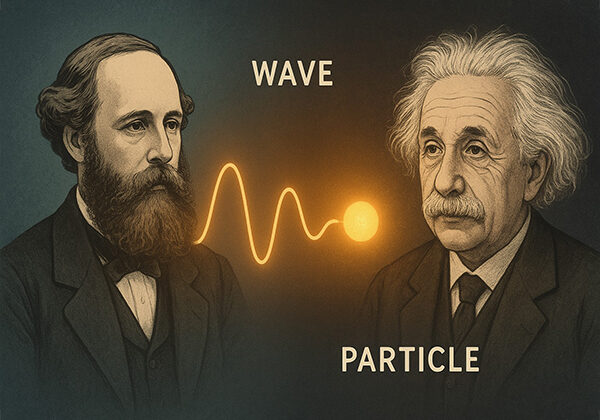
New Delhi [India], August 21: During a scientific seminar organised by the Department of Physics, Indian Institute of Technology Kanpur (IIT Kanpur) on the 18th August, Dr. Dhiraj Sinha, a faculty member at Plaksha University, delivered a lecture titled “Emergence of Einstein’s Photons from Maxwell’s Fields”. His talk was based on a recent article he published in Annals of Physics (Vol. 473, 169893, 2025).
Dr. Sinha spoke at length on how the particle nature of light, defined by photons, is deeply rooted in classical electromagnetic fields expressed through Maxwell’s equations. A subtle message from his discourse was that light’s particle nature is an emergent behaviour as a consequence of its interaction with matter.
Dr. Sinha began with a brief overview of historical context. Light was considered a wave until 1905, when Einstein published his work on the photoelectric effect. Einstein argued that light could be considered as packets of energy or light quanta, which later came to be called photons. According to Einstein, “When a light ray starting from a point is propagated, the energy is not continuously distributed over an ever-increasing volume, but it consists of a finite number of energy quanta, localized in space which move without being divided and which can be absorbed or emitted only as a whole.” Einstein’s concept is completely disconnected from the prior work by Maxwell who argued that light is an electromagnetic wave. The current belief is that light has a dual nature: it behaves like a wave in space but exhibits particle-like behaviour during its interaction with matter.
In the latter part of his lecture, Dr. Sinha focused his attention on his discovery that in light-matter interaction, the magnetic flux of light j, energises an electron of charge e, transferring energy given by e(dj/dt). Its frequency or phasor domain representation is ejw, where w is angular frequency. This term equals h’w, the energy of a photon, where h’ is the reduced Planck’s constant. He noted that magnetic flux quantisation has been observed in superconducting loops at two-dimensional electron gas systems, which supports his work. He argued that the uniqueness of his work lies in the fact that one starts from classical electromagnetism and derives a key result of quantum mechanics. The theoretical framework offers a bridge between the ideas of two great physicists- Maxwell and Einstein and has deep ploughing consequences regarding our understanding of the nature of light.
The discourse quickly evolved into a highly lively and heated debate with the professors from the Department of Physics, IIT Kanpur. The professors with a background in quantum field theory argued that Dr. Sinha’s theoretical framework was incomplete as it only focused on magnetic field of light while neglecting its electric field. They also raised the issue of the nature of gauge fixing used in the mathematical analysis.
Dr. Sinha countered the argument by showing that the electric and magnetic field of light can be expressed in terms of magnetic vector potential, a physical variable discovered by Franz Neumann in 1845. He further explained the underpinnings of Lorenz gauge in his arguments, which seemed to satisfy the professors.
During the next phase of the lecture, deeper disagreements and counter arguments started when Dr. Sinha highlighted the role of magnetic flux quantisation and its central role in understanding the nature of light. The IITK professors felt that using a concept from superconducting loops to make a general argument about the nature of light weakened his theoretical case. One of them argued that magnetic flux quantisation leads to the concept of magnetic monopoles, which have never been found. Dr. Sinha explained that magnetic field always forms closed loops and experimental results on magnetic flux quantisation in superconducting loops have a broader significance, which require more investigation.
In the final part, the discussion moved towards the nature of Maxwell’s equations in the context of discrete entities. Dr. Sinha suggested that Maxwell’s equations are silent about quantisation but are not opposed to it. They hold true for continuous as well as discrete physical quantities. He also pointed out that quantum physicists consider the discrete nature of electrons as classical but view other discrete quantities, like energy and magnetic flux, as quantum, and the framework lacks a coherent and homogenous basis.
He concluded by stating that his theoretical framework on the origin of the quantum nature of light in Maxwell’s electromagnetic fields offers a radically new perspective on the nature of light. Towards the end, the IIT professors largely agreed that the mathematical framework suggested by Dr. Sinha was coherent. However, they expressed the need for more experimental evidence, which specifically measure the magnetic flux of light in its quantised form.
The seminar was attended by the faculty members, students and researchers from a number of different departments viz. physics, chemical engineering and material science. The intense and profound exchange of ideas between the speaker and the faculty members was highly spirited and remarkable. It reignited a lively and intense debate on the physical nature of light, which remains a quintessential mystery of nature.